


HVAC Allergy Reduction Solutions across Southern California
Reasons to Choose AC Plus
-

Highly rated by our customers with 3,000+ 5-star reviews
-
Fair pricing with affordable financing options available
-
Fully stocked trucks to ensure timely repairs
-
Free estimates for system replacement or installation
-
Industry leading warranties and guarantees

There’s no fuss with the plus! Our team of heating & air conditioning professionals are ready to help. To schedule your service, give us a call at (760) 243-4440.
Pollen, pet dander, dust, and other airborne particles can enter a home and continue circulating through its heating and cooling system. In Southern California, long cooling seasons, High Desert winds, wildfire smoke, and year-round plant growth can make indoor particle control a recurring concern.
AC Plus Heating & Air Conditioning provides HVAC allergy reduction solutions across Southern California. Our licensed and certified technicians evaluate filtration, airflow, ductwork, humidity, and HVAC cleanliness to identify practical ways to reduce airborne irritants.
No HVAC product can eliminate every allergen or guarantee relief from allergy symptoms. However, a properly designed indoor air quality strategy may reduce the concentration and circulation of certain particles inside the home.
How Can an HVAC System Affect Indoor Allergens?
A central HVAC system moves large amounts of air throughout a home. As return vents draw air into the system, airborne particles travel with it. The filter captures some of that material, and the conditioned air then returns through the supply ducts.
When filtration and airflow are working properly, this circulation can support particle removal. When the filter is missing, poorly fitted, overloaded, or incompatible, contaminants may continue recirculating or collect inside the equipment.
The HVAC system can also contribute to indoor air concerns when:
- Return ducts pull dusty air from an attic or garage
- Duct leaks allow unfiltered air to enter
- Moisture collects near an indoor coil or drain
- A dirty blower or coil holds debris
- Airflow is too low
- The filter does not fit securely
- Maintenance has been delayed
- Humidity is consistently too high or too low
An effective allergy reduction plan considers the whole air-distribution system instead of relying on a single device.
What Allergens Are Common in Southern California Homes?
The particles found inside a home vary based on location, season, pets, landscaping, building condition, and household activity.
Common airborne irritants may include:
- Pollen
- Dust
- Dust-mite debris
- Pet dander
- Mold spores
- Insect debris
- Textile fibers
- Wildfire smoke particles
- Outdoor pollution
- Construction dust
High Desert communities such as Victorville and Apple Valley frequently experience windblown dust. Homes in Rancho Cucamonga, Redlands, Riverside, and San Bernardino may encounter pollen, traffic pollution, wildfire smoke, and particles from nearby construction.
Outdoor particles can enter through open doors, windows, ventilation openings, air leaks, clothing, shoes, and pets. Once indoors, ordinary movement can return settled material to the air.
What Are the Signs That Your Home May Need Allergy Reduction Solutions?
An HVAC and indoor air quality evaluation may be useful when:
- Dust returns quickly after cleaning
- Allergy-like irritation seems more noticeable indoors
- Pet dander circulates throughout the home
- Pollen seasons affect indoor comfort
- Smoke odors or particles enter during wildfire season
- Dust collects around supply registers
- The HVAC filter gets dirty unusually quickly
- Musty odors come from the vents
- Some rooms feel damp or stale
- Portable purifiers provide limited coverage
These symptoms are not a medical diagnosis. Anyone experiencing persistent, severe, or unexplained symptoms should consult a qualified healthcare professional.
HVAC service focuses on reducing airborne particles and correcting mechanical conditions that may contribute to poor indoor air quality.
Schedule an indoor air quality evaluation with AC Plus Heating & Air Conditioning to identify practical allergy reduction options for your home.
Which HVAC Solutions Can Help Reduce Allergens?
The appropriate combination depends on the particles involved, existing equipment, duct design, and household priorities.
Compatible Air Filtration
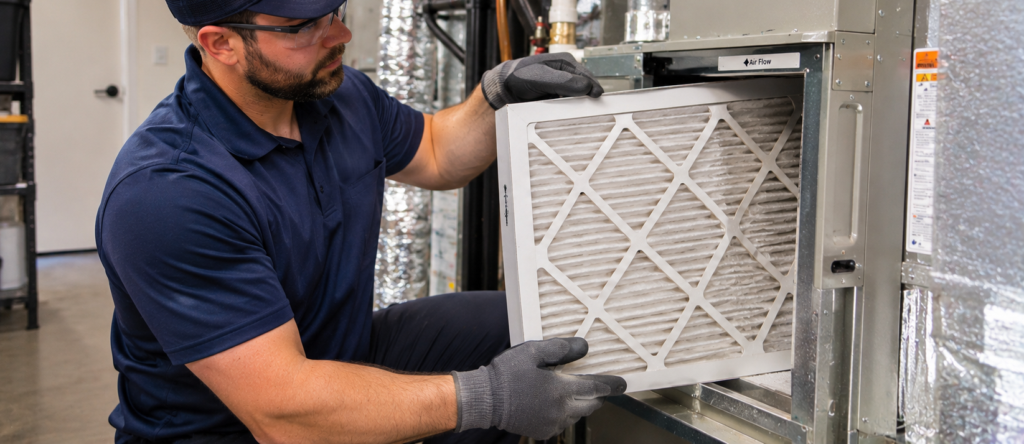
The air filter is the first line of defense for most central HVAC systems. A properly fitted filter captures qualifying particles before they enter the equipment and return to the living space.
Higher-efficiency filters may capture smaller particles than basic fiberglass filters, but they can also create greater airflow resistance. The selected filter must be compatible with the blower and ductwork.
Media Filter Installation
A media filter uses a larger, deeper filter cabinet. Its increased surface area may provide improved particle capture without creating the same level of airflow restriction as a small, tightly packed filter.
A technician can determine whether the HVAC system has enough space and airflow capacity for this upgrade.
Whole-Home Air Purification
A whole-home purifier works with the central HVAC system to provide broader air treatment. Depending on the equipment, it may use filtration, electronic air cleaning, UV treatment, activated media, or other technologies.
Product capabilities vary. The system should be selected based on a defined indoor air concern rather than broad promises.
Air Scrubbing Systems
Some air scrubbers combine multiple treatment methods to address particles and certain odors. These systems require professional selection, installation, and maintenance.
UV Light Installation
UV equipment is typically installed near the indoor coil or inside the ductwork. It may help control susceptible microorganisms in the treated area, but it does not physically remove dust, dander, or pollen. It is most effective as one part of a broader strategy.
Duct Sealing
Leaks on the return side of the duct system may draw dust and insulation particles from attics, wall cavities, garages, or crawl spaces. Professional duct sealing can help reduce this unfiltered air pathway.
Humidity Management
Excess humidity can support conditions favorable to mold and dust mites. Extremely dry air may increase discomfort and allow lightweight particles to remain airborne.
A whole-home humidifier or dehumidifier may be appropriate when measurements confirm an ongoing imbalance.
HVAC Maintenance
Routine maintenance helps keep coils, blowers, drain components, and other accessible areas clean and operating properly. It also gives technicians an opportunity to identify moisture or filtration problems.
How Does AC Plus Develop an Allergy Reduction Plan?
A one-size-fits-all product is rarely the best answer. AC Plus begins by reviewing the home and the specific concerns reported by its occupants.
The evaluation may include:
- Discussing symptoms and patterns: The technician asks whether concerns are seasonal, room-specific, related to pets, or worse when the HVAC system runs.
- Inspecting the air filter: Filter size, condition, rating, fit, and replacement history are reviewed.
- Checking HVAC airflow: Measurements and system condition help determine whether upgraded filtration is appropriate.
- Inspecting accessible equipment: The technician looks for dirt buildup, drainage issues, moisture, and signs of deferred maintenance.
- Reviewing duct conditions: Visible leaks, damage, poor connections, or excessive debris may contribute to particle circulation.
- Considering humidity: Indoor humidity readings can reveal whether moisture control should be part of the plan.
- Explaining suitable options: Homeowners receive straightforward information about benefits, limitations, maintenance, and cost.
Some homes may need only a correctly sized filter and routine maintenance. Others may benefit from a media cabinet, duct sealing, purification equipment, or humidity control.
How Do Filter Ratings Affect Allergy Reduction?
Filters are commonly rated using the MERV system. In general, higher MERV ratings indicate greater efficiency at capturing particles in specified size ranges.
However, filter performance depends on more than the number printed on the package. An effective filter must:
- Fit the cabinet without gaps
- Be installed in the correct direction
- Remain within the system’s airflow limits
- Be replaced before it becomes excessively loaded
- Receive enough circulating air to provide repeated treatment
Installing the highest-rated filter available can be counterproductive if it restricts airflow. Reduced airflow may lead to weak comfort, frozen coils, furnace overheating, long operating cycles, or equipment damage.
Professional evaluation helps balance particle capture with system performance.
How Often Should Allergy-Focused Filters Be Replaced?
Many residential filters require replacement every one to three months, but the ideal interval depends on the filter, system runtime, and household conditions.
Check filters more frequently when:
- The home has multiple pets
- Pollen levels are high
- Wildfire smoke affects the area
- Construction is taking place nearby
- The HVAC system runs continuously
- Doors or windows are frequently open
- The household has recurring dust concerns
- The filter has a small surface area
Do not wait until a filter is completely blocked. A restrictive filter can impair HVAC performance even if some clean material remains visible.
Can Duct Cleaning Help With Allergy Concerns?
Duct cleaning may be appropriate when an inspection confirms substantial debris, contamination, pest material, or construction residue inside the system. It is not automatically required for every home with allergies.
Cleaning does not prevent new particles from entering. It should be combined with source correction when the system has:
- Leaking return ducts
- An improperly fitted filter
- Moisture problems
- Pest entry
- Unsealed renovation areas
- Contaminated insulation
AC Plus offers duct-related indoor air quality services and can determine whether cleaning, sealing, repair, or filtration improvement is most relevant. The company also publishes guidance connecting HVAC maintenance, duct cleaning, and duct sealing with improved control of pollen and other indoor particles.
What Can Homeowners Do to Reduce Indoor Allergens?
HVAC improvements work best alongside everyday source-control measures.
A practical checklist includes:
- Replace HVAC filters on schedule
- Use kitchen and bathroom ventilation appropriately
- Vacuum with a well-maintained filtered vacuum
- Wash bedding regularly
- Groom pets and clean pet areas
- Remove shoes near the entrance
- Keep windows closed during high-pollen or smoke events
- Repair water leaks promptly
- Clean visible dust with a damp cloth
- Follow local wildfire air quality guidance
- Schedule HVAC maintenance
- Keep return vents unobstructed
Avoid applying fragrances or household chemicals merely to cover odors. Persistent musty, burning, gas, or sewage odors should be investigated at their source.
Why Choose AC Plus Heating & Air Conditioning?
Allergy reduction requires a balanced understanding of filtration, airflow, ducts, humidity, purification, and HVAC operation. AC Plus evaluates these factors together and recommends solutions based on the home rather than automatically prescribing one product.
Homeowners choose us for:
- Family-owned and operated service
- Southern California experience since 2001
- Licensed and certified technicians
- Upfront pricing
- HVAC and indoor air quality expertise
- Filter and media cabinet upgrades
- Whole-home air purification
- UV lights and air scrubbing systems
- Duct sealing and duct services
- Humidifier and dehumidifier installation
- Same-day service when available
AC Plus provides allergy reduction and related indoor air quality services throughout Victorville, Rancho Cucamonga, Apple Valley, Redlands, and surrounding communities.
Contact AC Plus Heating & Air Conditioning today to discuss HVAC allergy reduction solutions for your home.
Frequently Asked Questions About HVAC Allergy Reduction
Can an HVAC system cure allergies?
No. HVAC products do not diagnose, treat, or cure allergies. They may help reduce certain airborne particles as part of a broader indoor air quality plan.
Is a HEPA filter suitable for every HVAC system?
No. True HEPA filtration can create substantial airflow resistance and may require specialized equipment or a bypass configuration. A technician should confirm compatibility.
Should I leave the HVAC fan running all day?
Longer fan operation can move more air through a filter, but it also uses energy and may affect humidity or system performance. Ask a technician whether continuous or scheduled circulation is appropriate for your system.
Will UV lights remove pollen and pet dander?
No. UV equipment does not physically capture these particles. Filtration is the primary HVAC strategy for removing pollen and dander from circulating air.
Can duct sealing reduce dust?
It may help when return-side leaks are drawing dusty air from an attic, garage, crawl space, or wall cavity. Testing and inspection can determine whether leakage is significant.
Do I need both an air purifier and an upgraded filter?
Not necessarily. The right combination depends on the concern and existing system. Some homes benefit from filtration alone, while others may need several complementary measures.
Schedule HVAC Allergy Reduction Service Across Southern California
Reducing airborne allergens begins with identifying how particles enter, circulate, and leave your home. A compatible filter, sealed ducts, clean HVAC equipment, balanced humidity, and properly selected purification technology can work together to create a more controlled indoor environment.
AC Plus Heating & Air Conditioning serves Rancho Cucamonga, Victorville, Redlands, Wrightwood, Apple Valley, San Bernardino, Riverside, Ontario, and surrounding Southern California communities.
Schedule trusted HVAC allergy reduction service with AC Plus Heating & Air Conditioning today.
Service Request
"*" indicates required fields
